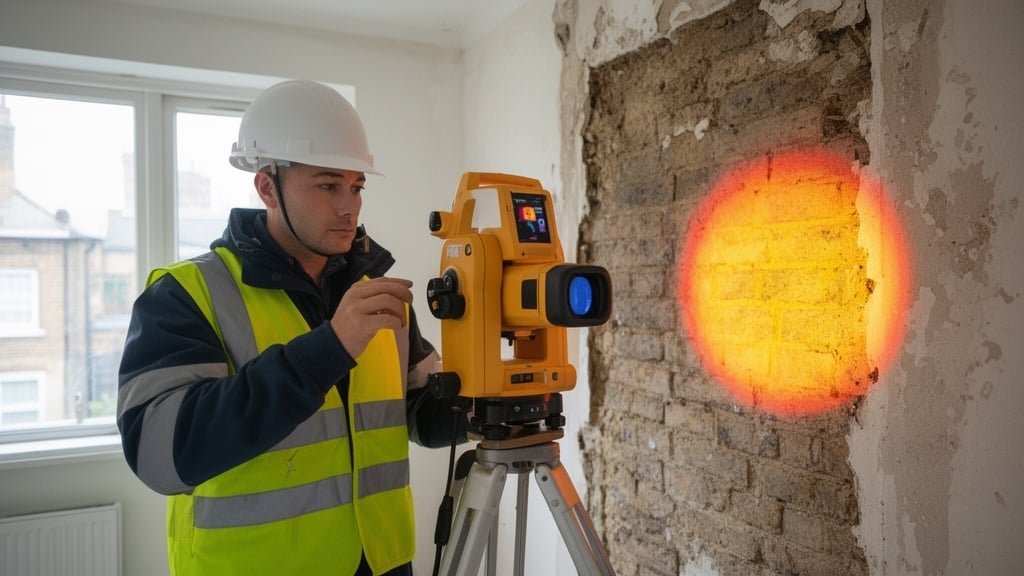
Property surveying has evolved dramatically over the past decade. Modern technology is transforming how our RICS chartered surveyors inspect buildings, identify defects, and provide detailed reports to home buyers. From thermal imaging cameras that detect hidden damp to drone surveys that examine difficult-to-access roofs, cutting-edge equipment enables us to provide more accurate, comprehensive, and safer property assessments than ever before.
The Evolution of Property Surveying Technology
Traditional property surveys relied heavily on visual inspection, basic tools like moisture meters and spirit levels, and the surveyor's experience. While these fundamentals remain important, technological advances have enhanced our ability to detect problems that would have been impossible to identify just twenty years ago. Modern surveying equipment allows us to see through walls, measure temperatures precisely, create three-dimensional property models, and document findings with far greater accuracy.
The integration of technology into property surveying serves multiple purposes. It improves accuracy by providing objective measurements and data rather than relying solely on subjective assessment. It enhances safety by allowing surveyors to inspect dangerous or inaccessible areas without physical risk. It increases efficiency by speeding up data collection and report preparation. Most importantly, it gives home buyers more comprehensive information about the condition of the property they're considering purchasing.
Our team at London Home Surveyors has invested significantly in the latest surveying technology to provide the best possible service to home buyers across East London, West London, South East London, and throughout the capital. Let's explore the key technologies that are revolutionizing property surveys and how they benefit you when buying a property in London.
Thermal Imaging Technology
Thermal imaging cameras are perhaps the most transformative technology in modern property surveying. These devices detect infrared radiation and create visual images showing temperature differences across surfaces. This capability allows our chartered surveyors to identify problems that are completely invisible to the naked eye, providing invaluable insights into the condition of the property.
Detecting Hidden Damp and Moisture
One of the primary applications of thermal imaging in property surveys is detecting damp and moisture problems. Wet areas appear cooler on thermal images because water evaporation causes cooling. Our surveyors can identify hidden damp behind walls, under floors, and in other concealed locations without any invasive investigation. This is particularly valuable in Victorian and Georgian properties where damp issues are common but often hidden behind decorations.
Thermal imaging reveals the extent of damp problems with remarkable clarity. While traditional moisture meters only test specific points, thermal cameras scan entire walls and ceilings in seconds, creating a complete picture of moisture distribution. This helps identify the source of damp, whether it's rising damp from failed damp proof courses, penetrating damp from external wall problems, or condensation from poor ventilation.
Identifying Insulation Defects
Thermal imaging is excellent for assessing insulation performance. Missing insulation in walls or ceilings shows up clearly as areas of different temperature. Our building surveyors use thermal cameras to check loft insulation coverage, identify gaps around windows and doors where heat escapes, detect areas where wall insulation has failed or was installed inadequately, and assess the effectiveness of double glazing.
For home buyers concerned about energy efficiency and heating costs, thermal imaging provides objective evidence about the property's thermal performance. This information helps buyers understand what improvements might be needed and budget accordingly. In the current climate of rising energy costs, knowing about insulation defects before purchase is increasingly valuable.
Detecting Electrical Hotspots
Thermal cameras can identify potentially dangerous electrical problems by detecting excessive heat at electrical components. Overheating connections, overloaded circuits, and failing electrical equipment all generate heat that shows up on thermal images. While our surveyors aren't electricians, thermal imaging alerts us to potential electrical issues that warrant specialist investigation.
The safety implications are significant. Electrical faults cause thousands of fires annually in UK homes. Identifying overheating electrical components during a property survey could literally be life-saving, as well as preventing expensive fire damage. Home buyers gain peace of mind knowing that potential electrical hazards have been identified and can be addressed before moving in.
Drone Technology for Roof and High-Level Inspections
Drones equipped with high-resolution cameras have revolutionized how surveyors inspect roofs and high-level areas of buildings. Traditional roof inspections required surveyors to climb ladders and walk on roofs, which posed safety risks and wasn't always possible on steep or fragile roof coverings. Drone technology eliminates these safety concerns while providing superior visual documentation.
Comprehensive Roof Surveys
Our chartered surveyors use drones to capture detailed images and video of roof coverings, identifying problems such as slipped, cracked, or missing tiles and slates, deteriorated roof valleys and flashing, damaged or unstable chimney stacks, sagging roof lines indicating structural issues, blocked or damaged gutters and downpipes, and moss or vegetation growth affecting roof coverings.
The quality of drone imagery is exceptional. Modern drones capture ultra-high-resolution photographs that can be zoomed in to examine tiny cracks or defects. Our surveyors can review these images carefully after the site visit, ensuring nothing is missed. The images also provide valuable documentation that's included in survey reports, giving home buyers visual evidence of roof condition.
Inspecting Tall Buildings and Difficult Access Areas
Drones are invaluable for inspecting tall buildings where traditional access would require expensive scaffolding or specialist equipment. Our building surveyors can examine upper floor windows, high-level brickwork, and parapet walls easily and safely. This is particularly useful for London properties including mansion blocks and high-rise apartments where upper floors would otherwise be inaccessible for detailed inspection.
The technology also allows inspection of dangerous areas without risk to surveyors. Unstable structures, hazardous roofs, and precarious locations can all be examined safely using drones. This means home buyers get more comprehensive information about their property's condition without surveyors taking unnecessary risks.
Creating Aerial Property Records
Drone surveys create a complete visual record of the property from all angles. These aerial photographs and videos document the property's condition at the time of survey, providing valuable baseline information for home buyers. The images can be referenced years later if issues develop, helping determine whether problems were pre-existing or occurred after purchase. This documentation can be crucial for insurance claims or disputes with sellers.
Advanced Moisture Detection Equipment
While basic pin-type moisture meters have been used in surveying for decades, modern moisture detection equipment offers far greater sophistication and accuracy. Our chartered surveyors use multiple types of moisture meters to build a complete picture of damp conditions throughout the property.
Non-Invasive Moisture Meters
Modern non-invasive moisture meters detect moisture without penetrating surfaces. These devices use radio frequency or electromagnetic technology to measure moisture content beneath plaster and other finishes. This is particularly valuable for assessing newly decorated properties where sellers might have covered up damp problems. Our surveyors can detect hidden moisture without marking or damaging walls.
The advantage of non-invasive meters is comprehensive coverage. Rather than testing just a few specific points with pin meters, surveyors can scan entire walls quickly to identify damp areas. The meters provide instant readings, allowing surveyors to focus detailed investigation on areas showing elevated moisture levels. This efficiency means more thorough damp assessment during the property inspection.
Deep Wall Moisture Probes
For suspected serious damp problems, our building surveyors use deep wall probes that can measure moisture content several inches into solid walls. Victorian and Georgian properties with solid brick walls often have damp penetrating deep into the masonry. Surface readings alone don't reveal the full extent of the problem. Deep probes provide accurate measurements of moisture distribution through the wall thickness.
This technology is crucial for distinguishing between different types of damp. Rising damp typically shows highest moisture readings at lower wall levels, declining with height. Penetrating damp creates isolated damp patches related to specific defects like leaking gutters. Condensation causes surface dampness without deep moisture penetration. Accurate diagnosis using advanced moisture meters ensures home buyers understand the true nature and extent of damp issues.
Digital Documentation and Reporting Systems
Modern surveying technology isn't just about detection equipment - it also encompasses how surveyors record and report findings. Digital systems have transformed survey reporting, making it faster, more accurate, and more comprehensive than traditional paper-based methods.
Tablet-Based Survey Recording
Our chartered surveyors use tablets with specialist software to record findings during property inspections. This digital approach offers numerous advantages including immediate photographic documentation with location tagging, instant annotation of images to highlight defects, standardized templates ensuring consistent coverage of all property elements, real-time data capture reducing transcription errors, and integrated measurement tools for accurate dimensional recording.
The efficiency gains are substantial. Surveyors can complete reports much faster because data doesn't need to be transcribed from handwritten notes. The risk of information being lost or misrecorded is eliminated. Most importantly, the quality and comprehensiveness of reports improve because surveyors can capture more detail more easily during the inspection.
Automated Report Generation
Digital survey software automatically generates formatted reports from data captured on-site. Our RICS level 2 surveys and level 3 building surveys are produced using systems that ensure consistent quality and completeness. The software prompts surveyors to inspect all required elements, reducing the risk of anything being overlooked. Reports are delivered to home buyers faster because there's no delay for manual typing and formatting.
Modern report systems also facilitate better communication. Digital reports can include hyperlinks to additional information, interactive floor plans showing defect locations, and embedded videos or audio commentary. Home buyers can review reports on computers, tablets, or smartphones, accessing information whenever needed. This accessibility ensures buyers fully understand the survey findings and can make informed decisions about their property purchase.
Laser Measuring and 3D Scanning Technology
Accurate measurements are fundamental to property surveying. Laser measurement devices and 3D scanning technology have dramatically improved measurement accuracy while reducing the time required for dimensional surveys.
Laser Distance Meters
Laser distance meters provide instant, accurate measurements of room dimensions, ceiling heights, and building features. Our property surveyors can measure distances up to hundreds of meters with millimeter accuracy. This is particularly useful for checking floor levels, identifying structural movement, measuring out-of-square rooms that might indicate structural problems, and verifying dimensions for valuation purposes.
The speed of laser measuring means surveyors can take more measurements during inspections, building a more complete picture of the property. Traditional tape measures are time-consuming and difficult to use accurately for long distances or in occupied properties. Laser meters eliminate these problems, enabling comprehensive dimensional surveys that were impractical previously.
3D Laser Scanning
For complex buildings or detailed analysis, 3D laser scanning creates complete three-dimensional models of properties. While this technology is more commonly used for commercial buildings or architectural purposes, it's increasingly applied to residential property surveys. The scans capture millions of data points, creating detailed models that can be examined long after the site visit. This technology is particularly valuable for properties undergoing renovation, as the scan provides an accurate baseline record of the existing building.
The Future of Property Surveying Technology
Technology continues to evolve, and future developments will further enhance property surveying capabilities. Our team at London Home Surveyors stays current with emerging technologies to provide the best possible service to home buyers. Several exciting developments are on the horizon that will shape the future of property surveys.
Artificial Intelligence and Machine Learning
AI systems are being developed to analyze survey photographs and automatically identify common defects. Machine learning algorithms trained on thousands of property images can recognize patterns associated with various problems, from cracked render to defective roof tiles. While AI won't replace experienced chartered surveyors, it will enhance our ability to identify issues and ensure comprehensive coverage during inspections.
Predictive analytics using AI could also help forecast future maintenance requirements based on current property condition and age. Home buyers could receive long-term maintenance forecasts alongside standard survey reports, helping them understand ongoing ownership costs and plan maintenance budgets.
Augmented Reality Survey Reports
Augmented reality technology could revolutionize how home buyers interact with survey reports. Instead of reading text descriptions and viewing photographs, buyers might walk through virtual property tours with defects highlighted and explained in context. This immersive approach would help buyers understand survey findings more clearly, especially those unfamiliar with building terminology.
Advanced Sensor Technology
Future developments in sensor technology will enable detection of issues currently difficult or impossible to identify. Sensors that detect gas leaks, measure air quality, identify electromagnetic field problems, and monitor structural vibrations could all become standard surveying equipment. These additions would provide even more comprehensive assessment of property condition and habitability.
Benefits of Technology-Enhanced Surveys for Home Buyers
The integration of modern technology into property surveying delivers tangible benefits for home buyers purchasing residential property across London. Understanding these benefits helps buyers appreciate the value of comprehensive, technology-enhanced surveys.
More Accurate Problem Identification
Technology provides objective data that supplements surveyors' professional judgment. Thermal imaging detects hidden damp that visual inspection would miss. Moisture meters quantify dampness rather than relying on subjective assessment. Drones capture detailed roof images showing defects invisible from ground level. This accuracy means fewer surprises after purchase and more reliable information for negotiating with sellers.
Comprehensive Documentation
Modern surveys include extensive photographic and video documentation of the property's condition. This visual evidence helps home buyers understand survey findings and provides a valuable record of the property at the time of purchase. If disputes arise about pre-existing defects, the documentation provides clear evidence of what was present at survey.
Faster Report Delivery
Digital survey systems enable faster report production without compromising quality. Our RICS chartered surveyors can deliver detailed reports within days of inspection, helping home buyers make timely decisions in London's fast-moving property market. This speed is crucial when competing for desirable properties or working to tight completion deadlines.
Better Value for Money
Technology-enhanced surveys provide more information for similar or lower costs than traditional surveys. The efficiency gains from digital systems and advanced equipment mean surveyors can offer comprehensive services at competitive prices. Home buyers get better value through more thorough inspections, more detailed reports, and more useful documentation.
Conclusion
Modern technology has revolutionized property surveying, enabling our RICS chartered surveyors to provide more accurate, comprehensive, and valuable services to home buyers. From thermal imaging that detects hidden damp to drones that safely inspect roofs, these technological advances deliver real benefits that protect your property investment and provide peace of mind.
At London Home Surveyors, we've invested in the latest surveying technology to ensure our clients receive the best possible service. Our building surveyors combine traditional expertise with cutting-edge equipment to provide thorough, accurate property assessments. Whether you need a RICS level 2 survey for a standard property or a comprehensive level 3 building survey for an older home, our technology-enhanced approach delivers the detailed information you need to make informed decisions about buying a property in London.
The future of property surveying will bring even more technological innovations, and we're committed to staying at the forefront of these developments. Contact our team of chartered surveyors today to arrange a comprehensive, technology-enhanced property survey across East London, West London, South East London, or anywhere in the London area.
Experience technology-enhanced property surveys
Book your comprehensive survey with our RICS chartered surveyors
Get Your Free Quote